Safety: The Details That Help You Stop
Standing upright on a 10-inch wheeled platform gives an electric scooter rider a much higher centre of gravity and shorter wheelbase than a bicycle. If you squeeze a strong brake with straight arms and locked knees, physics tips your mass forward over the handlebars long before the tyres reach their grip limit. Conversely, if you bend your knees and drop your hips back over the rear wheel while squeezing progressively, a dual-braked scooter stops from 20 km/h in roughly four metres—shorter than a city car.
Hardware and body habit work together. Here are the specific mechanical components and street habits that turn sketchy moments into controlled stops.
Comparing Brake Architectures on Real Streets
Being Seen at Car Wing-Mirror Height
Many scooters mount their rear brake light three inches above the wet road on the rear mudguard—completely invisible to an SUV or van driver sitting two metres behind you in stop-start dusk traffic. Supplement low deck lights with high-mounted cues:
STV
Headlight Optics · Road Courtesy
Horizon Cut-Off Beams (K-Mark / StVZO Spec)
Projects a wide carpet of 2.5W+ LED light onto dark tarmac potholes without throwing stray glare up into oncoming cyclists’ and drivers’ eyes.
Essential at dusk
IND
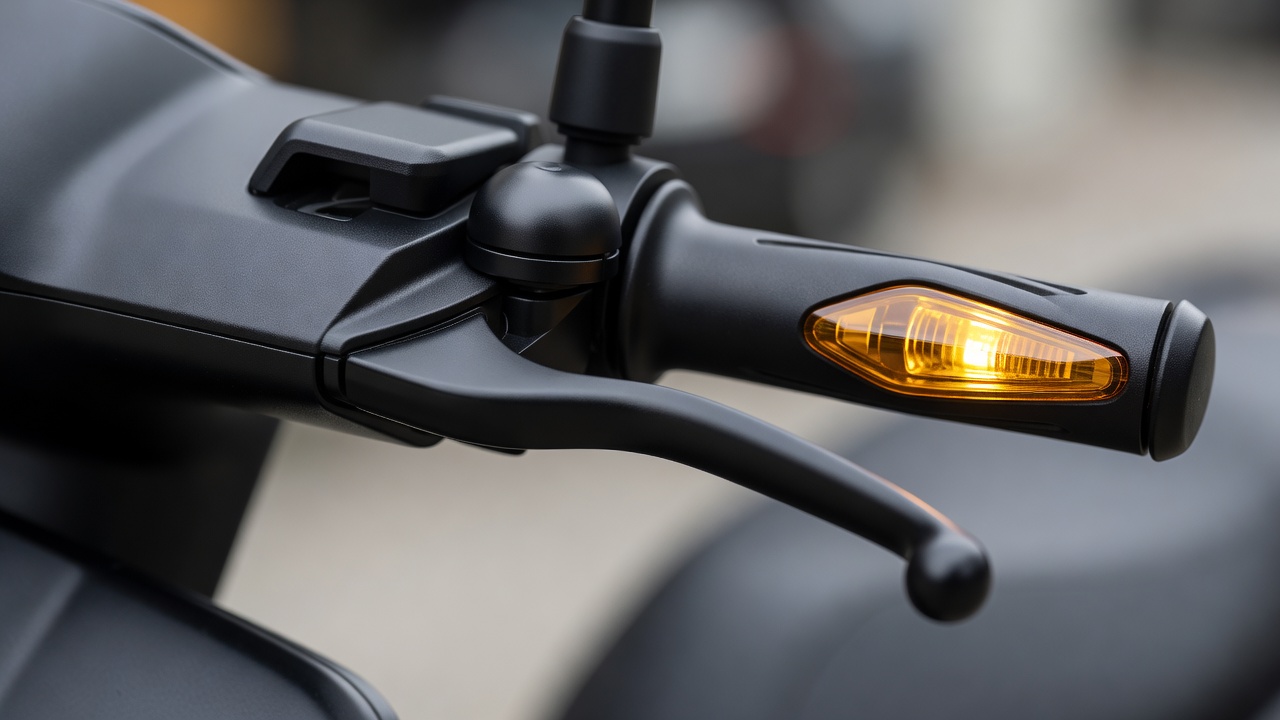
Directional Signalling
Bar-End Amber Indicators with Audible Click
Taking one hand off a scooter bar immediately destabilises steering. Thumb-operated bar-end blinkers visible from both front and rear let you signal lane changes with two hands planted.
Two-hand control
HLM
Head Protection & High Tail Light
NTA 8776 / EN 1078 Helmet with Rear LED
Choose a commuter helmet with deeper temple/occipital coverage (such as Dutch NTA 8776 speed-pedelec certified shells) and a rear red light right at driver eye level.
Eye-level beacon
Wet Surfaces, Tram Tracks and Local Riding Rules
“Treat wet metal drain covers, tactile brass studs, autumn plane leaves and thick white road paint like black ice: coast straight upright across them without braking, accelerating or leaning.”
— Wet-Weather Street Discipline
If your city has tram or light-rail lines (Manchester, Edinburgh, Amsterdam, Zurich, Melbourne, Toronto), cross recessed steel rails as close to a 90-degree angle as possible—small scooter tyres drop into flange grooves even faster than road-bike rims.
Know Your Local Micromobility Framework
Regulations vary sharply across jurisdictions and continue to evolve in 2026:
- Germany (eKFV): Requires an official Type Approval (ABE), 20 km/h cap, dual independent brakes, approved lighting and an adhesive annual liability insurance plate on the rear fender.
- France & Spain: 25 km/h speed limit, mandatory personal civil-liability insurance in France and growing municipal DGT certification and helmet rules across Spanish cities; strictly banned on pedestrian pavements.
- United Kingdom: Authorised rental trial scooters are permitted on roads and cycle lanes for licence holders, whereas privately owned electric scooters remain restricted from public highways and pavements pending dedicated transport legislation. Always verify current local enforcement before riding.
- United States & Canada: Regulated state-by-state and city-by-city—typically permitted in bike lanes and 25–30 mph streets with 15–20 mph speed caps; check municipal transit policies before bringing larger models onto buses or subways.